

TL;DR:
- The term “market stall toy” can mean a miniature toy shop, market novelties, or promotional items.
- UK toy safety regulations require CE or UKCA marks and proper documentation for children’s toys.
- Retailers should verify compliance, ask for documentation, and avoid unverified sources to ensure legal sale.
Running a market stall sounds straightforward until you try to buy stock and realise the phrase “market stall toy” means completely different things depending on who you ask. Are you buying a miniature toy shop for children to play pretend? A bag of novelty prizes for a fairground stall? Or something in between? For UK retailers and market vendors, getting this wrong is not just confusing. It can land you in genuinely murky legal territory. This guide cuts through the noise, explains what the term actually covers, and gives you a clear framework for sourcing, selling, and staying on the right side of UK toy safety regulations.
Table of Contents
- What is a market stall toy?
- How UK toy regulations apply to market stall toys
- Toy vs. novelty item: How to make the distinction
- Top considerations for sourcing and selling market stall toys
- Why most market stall toy pitfalls are avoidable
- Find trusted bulk toys and novelties for your UK stall
- Frequently asked questions
Key Takeaways
| Point | Details |
|---|---|
| Know the categories | Market stall toys can mean playthings, novelties, or party goods, but only toys intended for children are regulated. |
| Check compliance | Only buy and sell products with clear CE or UKCA markings and proper documentation in the UK. |
| Ask the right questions | Confirm intended age, use, and compliance details before committing to any bulk purchase for resale. |
| Avoid unsafe sources | Stay away from unverified or grey-market suppliers who may offer untested or unsafe goods. |
What is a market stall toy?
Let’s be honest: the term “market stall toy” is doing a lot of heavy lifting. It gets used in three quite different ways, and if you are buying stock in bulk, you need to know which one you are dealing with.
First, there is the literal interpretation. A market stall toy is a toy stall, a small, usually wooden or plastic play set designed for children to act as a shopkeeper. Think miniature fruit stands, pretend bakeries, and toy fish-and-chip counters. These are intended for imaginative play and are firmly categorised as children’s toys.
Second, the phrase is used loosely by some traders to describe toys and novelties sold at market stalls. This includes everything from bouncy balls to foam gliders, prize toys, and party bag fillers. As Andy Morant Toys at Portobello Market demonstrates, seasoned traders know the phrase can be ambiguous: it covers role-play stalls for pretend play as well as market-style novelty items sold at actual stalls, so retailers should always verify the product category, age guidance, and whether the item is a regulated toy or simply a novelty item.
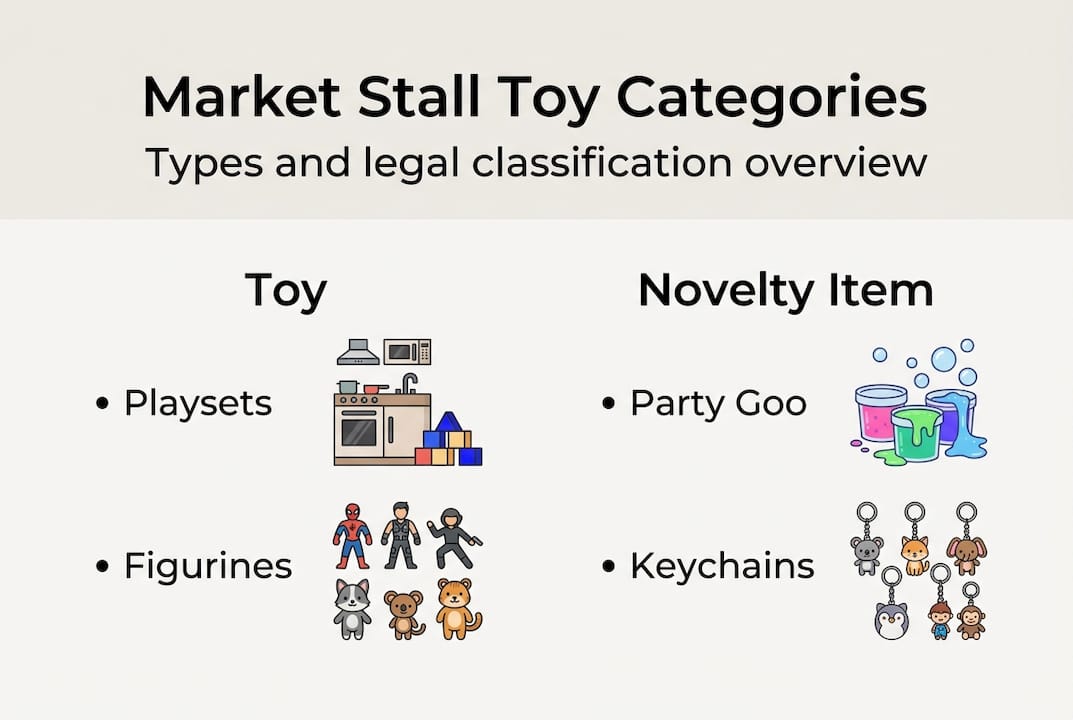
Third, you have the grey area: novelty and promotional items that look like toys but may not be legally classified as toys at all. Think keyrings shaped like animals, decorative erasers, or seasonal trinkets.
Here is a quick comparison to help you sort your stock:
| Product type | Example | Likely classification |
|---|---|---|
| Pretend play stall set | Toy market stall with accessories | Toy (regulated) |
| Prize toy | Bouncy ball, foam glider | Toy (regulated) |
| Novelty item | Decorative keyring, trinket | Novelty (may be unregulated) |
| Seasonal decoration | Plastic Halloween figure | Depends on intended use |
Some things to check before you buy:
- Age guidance on the packaging (under 14 typically means toy regulations apply)
- Intended use: is it meant to be played with by a child?
- Construction materials and any small parts warnings
- Whether the supplier classes it as a toy or a novelty
For a deeper look at the novelty side of things, our novelty items guide is worth a read before you fill your next order.
Pro Tip: When in doubt about a product’s classification, ask your supplier directly. If they cannot tell you whether it is a toy or a novelty, that is a red flag worth taking seriously.
How UK toy regulations apply to market stall toys
Once you understand the varying definitions, the next step is to see how regulations actually shape what you can sell. And here is where things get genuinely important for your business.
The Toys (Safety) Regulations 2011 set the legal standard in the UK. If a product is a child’s plaything, it will generally fall under the UK toy regulatory scope when it is designed or intended for play by children under 14. That is a broad net, and it catches a lot of items that casual traders might not expect.
Here is what compliance actually looks like in practice:
- CE or UKCA marking must appear on every regulated toy sold in the UK
- Safety testing must be conducted and documented before the toy reaches the market
- Age guidance must be clearly displayed on the packaging
- Warning labels for small parts, choking hazards, or restricted age groups must be present
- Technical documentation must be held by the manufacturer or importer, available on request
The responsibility does not just sit with the manufacturer. As a retailer placing toys on the market, you share legal accountability. If you are buying from a wholesaler to resell, you need to be confident your stock is compliant before it hits your stall.

For a more detailed breakdown of what running a compliant stall looks like day to day, our guide on how to run a toy stall covers the practical side well.
The toy safety guidance from CCST also reminds buyers to be especially cautious with items sourced from online marketplaces or less controlled channels. The markings can be faked. The documentation can be missing. Knowing what UKCA marked toys actually look like gives you a real advantage when vetting suppliers.
| Marking | Market | Valid for |
|---|---|---|
| CE | EU and UK (transitional) | Toys manufactured before 2027 cutoff |
| UKCA | Great Britain only | Toys placed on GB market post-Brexit |
Pro Tip: Keep a simple compliance checklist for every new product you add to your stall. Marking present? Age guidance visible? Supplier documentation available? If all three are yes, you are in good shape.
Toy vs. novelty item: How to make the distinction
Understanding who is responsible for safety, the challenge becomes how to sort the toys from the novelties. And this distinction matters more than many traders realise.
Let’s be clear: not everything sold at a toys and novelties stall is legally a toy. A decorative item, a collector’s piece aimed at adults, or a promotional giveaway might sit outside toy regulations entirely. But the moment a product with a child-focused design lands in a child’s hands as a plaything, it likely crosses into regulated territory, regardless of how the seller labels it.
The CCST toy safety guidance makes this plain: toys should carry CE or UKCA marks, and buyers should be cautious with items from less controlled purchasing channels. The label on the box does not always tell the full story.
“If the item is designed or intended for play by children under 14, it counts as a toy under UK law, regardless of what the seller calls it.”
Here are the key differences to watch for:
| Item | Child-focused design? | Intended as a plaything? | Classification |
|---|---|---|---|
| Rubber duck bath toy | Yes | Yes | Toy |
| Animal-shaped keyring | Sometimes | Sometimes | Check carefully |
| Novelty eraser set | Yes | Likely | Probably a toy |
| Seasonal ornament | Sometimes | No | Novelty/decoration |
Some practical signals that an item is likely a regulated toy:
- It features characters or designs clearly aimed at children
- It is sized and shaped to be held and manipulated by small hands
- It is sold alongside or packaged like children’s toys
- The packaging suggests it is a gift for a child
For more guidance on getting your stock mix right, our good retail toy guide is a solid starting point. If you are sourcing novelties specifically, our advice on safe novelty item sourcing keeps you on the right side of the line. And always cross-reference with the Toy regulations on GOV.UK when you are unsure.
Top considerations for sourcing and selling market stall toys
Applying this knowledge, here is how smart UK vendors put compliance and practical retail advice into action. Because knowing the rules is one thing. Actually buying confidently is another.
-
Ask for compliance documentation upfront. Before you place a bulk order, ask your supplier for proof of CE or UKCA marking. A reputable wholesaler will have this ready. If they hesitate or go quiet, walk away.
-
Avoid grey-market platforms. Unbranded bulk toys from unverified online sellers are a gamble. The price might look brilliant, but the hidden cost of selling non-compliant stock far outweighs any saving.
-
Check labelling on every product line. Even within a single order, labelling can vary. Check age guidance, safety warnings, and markings on each product, not just the catalogue description.
-
Know your legal position. UK businesses placing toys on the market must ensure compliance before sale. This applies to you as a retailer, not just the manufacturer.
-
Stock seasonally but compliantly. Themed and seasonal toys sell brilliantly at market stalls. Halloween toys, Easter fillers, Christmas novelties: they fly off the table. Just make sure they carry the right markings, especially items that are quickly turned around for short seasonal windows.
Some additional buying tips worth keeping in your back pocket:
- Prioritise suppliers with a clear compliance policy and traceable product origins
- Look for suppliers who display safety certifications on their product pages
- Read our affordable toy safety guide for more budget-conscious buying advice
- Use our B2B toy buying guide to structure your seasonal purchasing decisions
- Check toy safety tips from CCST for an independent reference point
Pro Tip: Build a simple supplier vetting sheet. Name, product range, compliance documentation received, and date verified. It takes ten minutes to set up and saves you enormous headaches down the line.
Why most market stall toy pitfalls are avoidable
After all these practical tips, let’s get honest about why compliance issues keep cropping up among market vendors. Because they do, and it is rarely because traders are careless. It is usually because they are busy.
Most problems come from assumption. A seller sees CE marked on the outer carton and assumes every item inside is compliant. Or they trust a product description that says “safe for children” without checking what that actually means in legal terms. These are human shortcuts, not deliberate risks.
Here is the uncomfortable truth: compliance is rarely complicated once you know what to ask for. The documentation exists. The markings exist. Verified suppliers have it all ready. The problem is that many traders simply never ask.
Our experience tells us that the vendors who get improving toy safety right are not the ones with the most resources. They are the ones who ask one extra question per supplier and keep records of the answers. That is genuinely all it takes.
Vet every new supplier. Stock toys that are clearly compliant. And do not let a bargain price override your common sense. You’ve got this.
Find trusted bulk toys and novelties for your UK stall
Ready to stock your stall with toys you can genuinely trust? That is where we come in.
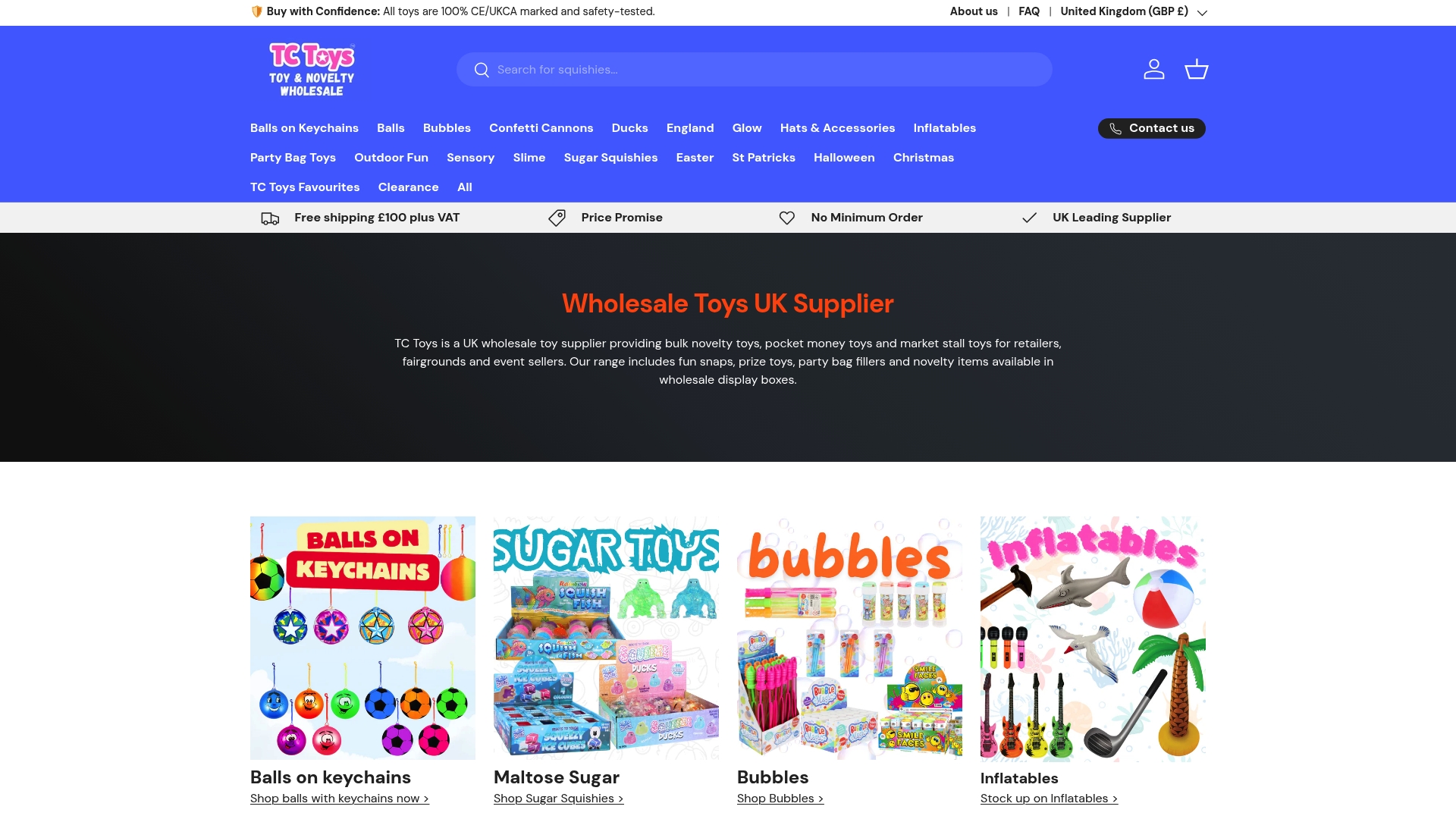
At TC Toys, every product in our range is CE or UKCA marked and safety-tested for UK compliance. Whether you are filling party bags, stocking a school fete prize table, or loading up for a busy weekend market, our wholesale party bag toys and bulk market stall toys give you variety, value, and the peace of mind that comes from buying through a verified UK wholesaler. We also stock a brilliant range of PTA event supplies for school and community events. No minimum order. Fast UK delivery. Compliant stock ready to go.
Frequently asked questions
Does every toy sold at a UK market stall need to be CE or UKCA marked?
Yes. The Toys (Safety) Regulations 2011 require CE or UKCA marking on every toy intended for children under 14. There are no exemptions for small traders or informal market settings.
How can I tell if an item is classed as a toy or a novelty product?
If the item is designed or intended for play by children under 14, it counts as a toy under UK toy law and must meet full safety requirements. The seller’s label does not change the legal classification.
What documents should I ask suppliers for when buying bulk toys?
Always request CE or UKCA marking certificates and confirmation that the products meet UK toy safety standards. Reputable suppliers will have this documentation ready without hesitation, as businesses must ensure compliance before placing toys on the market.
Can I sell imported toys not labelled for the UK market?
No. Toys sold in the UK must display UKCA or CE marking and meet UK standards. Non-compliant imported toys cannot legally be sold to UK customers, regardless of where they were purchased or how they were described by the overseas supplier.