

TL;DR:
- UK safety standards require CE or UKCA marks and EN71 compliance on novelty toys.
- Post-season clearance sales offer the best prices, especially after major holidays.
- Vet suppliers by requesting conformity documents and avoiding reluctance to share compliance evidence.
Imagine ordering a crate of novelty toys for your market stall or school fair, only to discover on the day that half the items carry no safety markings whatsoever. Cue the stress, the refunds, and the very real risk of a Trading Standards visit. It happens more often than you’d think, and the consequences range from a bruised reputation to serious legal trouble. This guide walks you through exactly how to source wholesale novelty items the right way: safe, affordable, fully compliant, and perfectly timed for whatever occasion you’re planning next. From spotting dodgy suppliers to nailing your buying calendar, you’ve got this.
Table of Contents
- What to look for in wholesale novelty items
- How to time your purchasing for best prices
- Conducting due diligence on novelty suppliers
- Avoiding counterfeits and legal pitfalls
- Why safety-first thinking pays off long-term
- Find safety-certified, affordable novelty items for your next UK event
- Frequently asked questions
Key Takeaways
| Point | Details |
|---|---|
| Check legal certifications | Always insist on UKCA/CE marks and EN71 compliance for all novelty toys and items. |
| Time your purchase | Buy after seasonal peaks for maximum wholesale discounts on novelty products. |
| Vet all suppliers | Request technical files, test reports, and verify supplier credentials before placing orders. |
| Beware of counterfeits | Avoid fake and recalled toys by buying from trusted, well-documented sources. |
What to look for in wholesale novelty items
Before you even think about price, you need to know what a safe, suitable novelty item actually looks like. In the UK, the rules are clear. Under the Toys (Safety) Regulations 2011, every toy sold or supplied must meet rigorous safety standards, which means UKCA or CE marking and EN71 compliance are non-negotiable starting points.
EN71 is the European and British safety standard for toys, covering everything from physical and mechanical properties to flammability and chemical content. Parts 1 to 3 are the ones most relevant to novelty items: structural integrity, fire resistance, and the absence of harmful chemicals. If a product doesn’t clearly reference these, walk away.
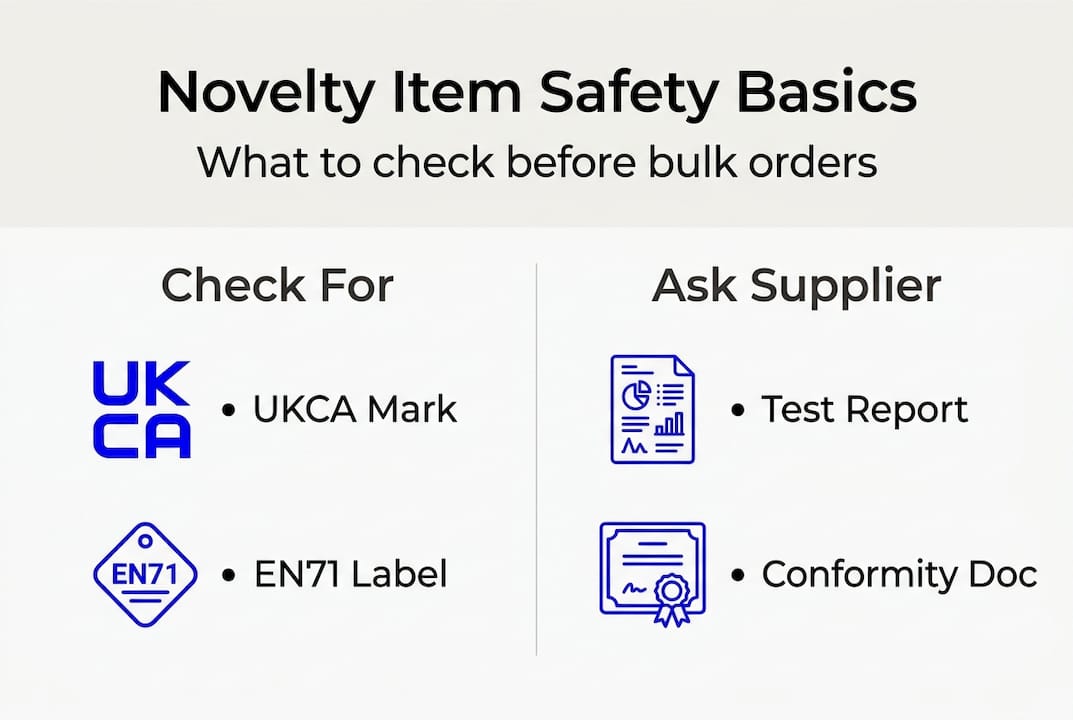
Understanding the difference between markings matters too. UKCA marking is the UK’s post-Brexit equivalent of CE, and while both are currently accepted in Great Britain, UKCA is now the standard you should prioritise for new stock. For a deeper look at what these markings actually mean for you and your customers, CE and EN71 explained is worth a read before you place any large orders.
Your practical checklist before buying:
- UKCA or CE mark clearly visible on packaging
- EN71 Parts 1, 2, and 3 referenced
- Age suitability labelling (especially important for items near children under 3)
- Manufacturer or importer name and contact details on packaging
- Warning statements present where required (e.g. choking hazard notices)
- No strong chemical smell or obvious sharp edges on samples
Here’s a quick comparison of what compliant versus non-compliant packaging typically looks like:
| Feature | Compliant product | Non-compliant product |
|---|---|---|
| Safety mark | UKCA or CE present | Mark absent or unclear |
| EN71 reference | Clearly printed | Not mentioned |
| Age guidance | Stated on packaging | Missing or vague |
| Manufacturer details | Full name and address | Anonymous or generic |
| Warning labels | Present and legible | Absent or in wrong language |
For broader guidance on what makes a product genuinely fit for retail environments, the retail toy shopping tips resource is a solid reference.
Remember: Supplying non-compliant toys, even unknowingly, can result in enforcement action, product recalls, and reputational damage. The legal responsibility sits with the retailer or distributor, not just the manufacturer.
Pro Tip: Always request a physical sample before committing to a bulk order. Check the markings yourself rather than relying solely on a supplier’s product listing.
How to time your purchasing for best prices
Now that you know what to look for, timing your purchases smartly can make a genuine difference to your margins. The wholesale novelty market runs on seasonal cycles, and if you learn to work with those cycles rather than against them, you’ll consistently pay less for better stock.

Post-season clearances are where the real bargains live. Suppliers and distributors routinely discount lines after their peak window has passed, meaning a savvy buyer can stock up on Halloween items in November or Christmas novelties in January at a fraction of the original wholesale price. The trick is knowing which clearances are genuine value and which are just end-of-line stock nobody wants.
Here’s a simple buying calendar to work from:
- January to February: Post-Christmas clearance. Ideal for stocking up on general novelty items, party fillers, and gift lines at lowest prices.
- March: Pre-Easter buying window. Order early to secure best selection before prices rise closer to Easter weekend.
- June to July: Summer fair and fete season. Order party bag fillers, outdoor prizes, and fun snaps 6 to 8 weeks ahead.
- August: Early Halloween buying. Prices are lower before September demand spikes.
- October: Pre-Christmas sourcing begins. Lock in your Christmas novelty lines before stock shortages hit.
- November: Post-Halloween clearance for novelty stock with longer shelf life.
Of course, price isn’t everything. A clearance line that arrives too late for your event, or one that turns out to be poor quality, is no bargain at all. For practical guidance on keeping costs sensible without cutting corners, affordable sourcing strategies breaks this down well.
| Buying window | Discount potential | Risk level | Best for |
|---|---|---|---|
| Post-season clearance | High (20%–50%) | Medium | Generic novelties, evergreen stock |
| 6–8 weeks pre-event | Moderate | Low | Targeted seasonal items |
| Last-minute (1–2 weeks) | Low | High | Emergency top-ups only |
| Off-peak (no event link) | High | Low | Long shelf-life lines |
For a broader view of how buying cycles play out across the UK market, B2B toy market insights gives useful context on demand patterns and planning horizons.
Pro Tip: Build a simple annual buying planner with key event dates and work backwards 8 weeks from each. You’ll rarely get caught scrambling at the last minute, and you’ll almost always pay less.
Conducting due diligence on novelty suppliers
Timing your purchase is only half the battle. The supplier you choose is arguably more important than the price tag. A polished website and low minimum order quantities can mask a supplier who simply isn’t up to standard. Here’s how to check.
The foundation of good supplier vetting is documentation. Any reputable wholesale supplier should be able to provide the following without hesitation:
- Technical file: The detailed record proving a product meets safety standards
- Declaration of Conformity (DoC): The supplier’s formal written statement that the product complies with applicable regulations
- Lab test reports: Third-party testing evidence, ideally from a UKAS-accredited or equivalent laboratory
- Product samples: Physical examples for your own inspection before committing
Beyond paperwork, supplier audits and lab testing offer a more rigorous level of assurance, particularly for higher-volume buyers or event organisers supplying children directly.
Step-by-step supplier vetting process:
- Request the DoC and EN71 test reports for every product line you intend to stock.
- Cross-reference the test reports with the actual products, checking batch numbers and descriptions match.
- Ask directly whether the supplier carries product liability insurance.
- For inflatables or chemical-based novelties, specifically ask for evidence of chemical safety testing.
- Check for online reviews, trading history, and any past enforcement actions.
- If ordering at significant volume, consider requesting a virtual or on-site audit of the supplier’s quality controls.
For event organisers in particular, the guidance on running a compliant toy stall is genuinely useful when thinking about how supplier compliance translates into event-day readiness.
Pro Tip: If a supplier is reluctant to share a Declaration of Conformity or test reports, that reluctance is itself a red flag. Legitimate suppliers keep this documentation readily available.
Avoiding counterfeits and legal pitfalls
Once you’ve checked your supplier, staying alert to counterfeits is crucial. This isn’t a minor issue. In 2025, over 259,000 fake toys were seized, with a combined value of £3.5 million, and many were found to contain cancer-linked chemicals. The scale of the problem in the UK is genuinely alarming, and the harm isn’t just financial.
Counterfeit novelty toys typically share a set of recognisable warning signs. Keep an eye out for:
- Safety markings that look blurry, inconsistent, or printed rather than moulded
- Packaging with spelling mistakes, vague manufacturer details, or no UK-relevant contact information
- Prices so low they defy logic, especially on branded or premium-looking items
- Strong chemical odours from plastic components
- No age labelling or warning statements
- Poor quality packaging that tears or damages easily on first handling
Key fact: Retailers and event planners who knowingly or unknowingly supply counterfeit toys face prosecution under the Consumer Protection Act 1987, potential civil liability, and seizure of stock. The financial and reputational consequences can be severe.
If you encounter suspicious products, report them to your local Trading Standards office via the Citizens Advice consumer helpline on 0808 223 1133. You can also report online through the Trading Standards Institute. Acting quickly protects not just your business, but the children your events are meant to delight.
The uncomfortable truth is that the allure of ultra-low prices is exactly what counterfeiters bank on. If a deal seems too good to be true in the wholesale novelty world, it almost certainly is.
Why safety-first thinking pays off long-term
Here’s a candid take on something many buyers only figure out after a painful experience. Chasing the lowest price without checking compliance isn’t actually saving money. It’s borrowing against future losses.
We’ve seen it play out repeatedly in the UK event and retail sector. A retailer saves a few pence per unit by going with an untested supplier, and then loses far more in unsold stock, customer complaints, or worse, a Trading Standards investigation. The maths simply doesn’t work in favour of cutting corners.
Safety-first sourcing, on the other hand, builds something worth far more than a single event’s margin: trust. Customers who buy from your stall and find the items are solid, well-marked, and genuinely fun will come back. Event organisers who deliver safe, well-sourced prizes earn a reputation that fills future events without extra marketing spend.
There’s also the peace of mind factor, which frankly has real business value. Knowing your stock is compliant means you can focus on selling, promoting, and creating a great experience rather than worrying about what’s in the packaging. Balancing cost and quality isn’t about spending more. It’s about spending wisely and building a business that lasts.
Find safety-certified, affordable novelty items for your next UK event
You now know what to look for, when to buy, and how to vet your sources. The next step is finding a supplier who ticks every one of those boxes without making you jump through hoops.
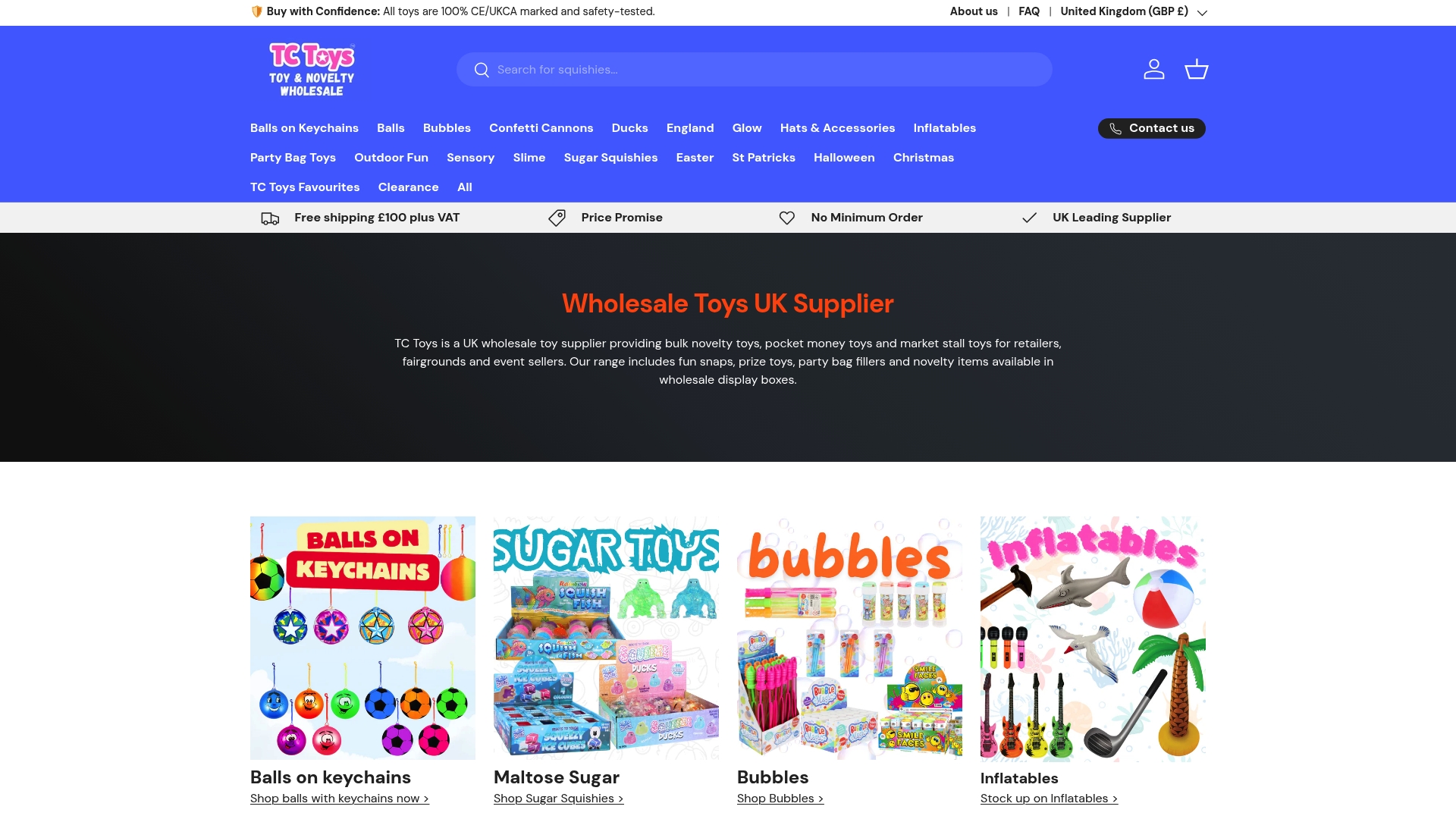
At TC Toys, every product is CE or UKCA marked and safety-tested, so you can order with confidence rather than crossed fingers. Whether you’re filling party bags, stocking a prize stall, or planning a seasonal promotion, explore the CE marked party bag toys range for compliant, crowd-pleasing options at wholesale prices. For themed and time-sensitive buys, the seasonal novelty collections cover everything from Halloween to Easter. Ready to see the full range? Browse all novelty ranges and find your next bestseller today.
Frequently asked questions
What safety markings should I check for on wholesale novelty toys in the UK?
Always check toys for UKCA or CE marks and ensure they meet EN71 parts 1 to 3 to comply with UK safety laws.
When is the best time to buy novelty items at wholesale prices in the UK?
Buying after peak seasons, such as January and February post-Christmas, helps secure maximum discounts, as post-season clearances consistently offer the deepest price reductions on novelty stock.
How do I verify that a wholesale supplier is legitimate and compliant?
Ask for technical files, Declarations of Conformity, and recent lab test reports, then review supplier audit credentials before committing to any purchase.
What are the risks of selling counterfeit novelty toys?
Selling fakes can result in prosecution, stock seizure, and serious harm to customers, as 259,000 fake toys seized in 2025 included items containing dangerous, cancer-linked chemicals.
Recommended
- What are novelty items? A UK event planner’s guide – TC Toys
- Top 7 Cheap Cards for UK Retailers 2026 – TC Toys
- Smart tips for sourcing affordable toys for children’s parties – TC Toys
- Why UKCA marked toys offer peace of mind for UK buyers – TC Toys
- Emerging Children’s Toy Safety Tech Innovations in 2026 – ToylandEU